In March we decided we needed a weekend away from our sometimes too-small town.
We decided to check out a small city called Comarapa, about a 4-hour motorcycle ride away.
We had seen it on a poster promoting tourism in the area.
Also, Andy had heard that there was a large man-made lake near it, and he remembered it being described as “un lugar bien turístico” (a very touristy place).
I will never again hear the phrase, “un lugar bien turístico,” without laughing uncontrollably.
We decided to head for Comarapa on a Friday afternoon, thinking we’d stay the whole weekend and get back late Sunday night. The four-hour motorcycle trip was uncomfortable; even the small amount of luggage we were carrying (one change of clothes each plus a couple books), when strapped on the tiny rack on the back of the motorcycle, forced me to ride Andy like a backpack (or vice versa). Still, the weather was nice, so we were in high spirits. We arrived in Comarapa at about 2 in the afternoon. Since we didn’t know our way around, we stopped at the central market to get drinks and ask questions. We have discovered that, in rural Bolivia, it’s always best to ask directions from three or four different people (we think this is both because we don’t understand Spanish as well as we think we do, and because for some reason rural Bolivians offer directions even if they have no idea what you’re talking about). So, we asked the lady that sold us drinks, a couple resting on a street corner, and a shop-owner what they knew about the lake. The answers were all the same. Yes, it’s a beautiful lake. Yes, it’s a “lugar bien turístico.” Yes, there are places to swim. There might even be a place to stay.
Excited by the prospect of a dip in a real live lake and maybe even a boat ride (Andy had heard there were boats for rent), we headed toward the lake, another 15 minutes passed the city on a dusty, bumpy dirt road. We arrived at a point overlooking the lake and could see that it was, indeed, a real lake. We could see the dam on the far side, and a couple buildings near it. “Hey maybe that’s where they rent boats!” I exclaimed. Andy nodded hopefully inside his helmet.

Comarapa lake: great views…and that’s about it.
As we neared the dam, however, we started having doubts. There was no one there. No one. And it was a beautiful, hot, sunny day, perfect for swimming or boating. We got to the dam and stopped to look around. No one. We were close to the buildings now, and both suspected but did not voice what turned out to be the truth: they were abandoned. Nothing. Nada. We pulled into an overgrown driveway at one of the buildings. “Where’s the boat launch?” Andy asked no one in particular. We both started laughing and shaking our heads.

Comarapa Lake Boat Launch and Resort...or not
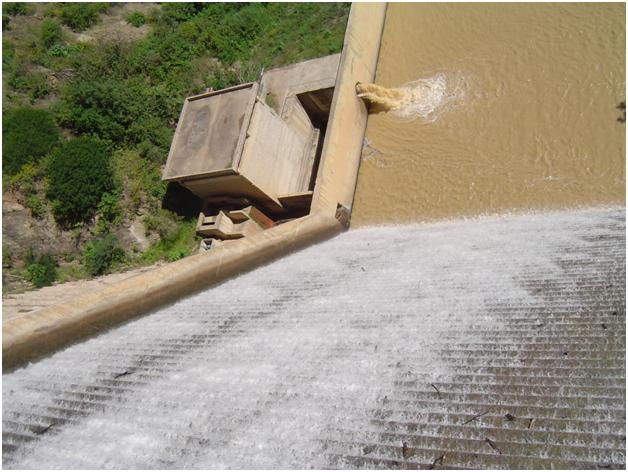
He turned the motorcycle around. “Surely there’s a place to swim,” I said. We were still hopeful. We stopped again on the dam, this time appreciating it as possibly the only thing worth seeing.

Comarapa dam: "Worth the trouble."
“Hey look!” I said, pointing at a little outcropping of land about halfway down the lake, back the way we had come. “There’s a road leading down to that little peninsula, and it looks like nice grass right up to the water. I bet we can swim there.”
“Let’s check it out,” Andy replied, firing up the motorcycle.
We found the entrance to the road and followed it down to the water’s edge. I stripped down to my bathing suit and sandals. Andy removed his shoes. We walked closer and looked around.
There was nothing to do but laugh. The whole area surrounding the water’s edge was covered in cow patties and discarded condoms. Just next to what I had, from afar, declared as the “swimming beach,” a line of rusty barbed wire filed into the water and disappeared. We could see more fence-posts farther out. Everything smelled weird. We laughed again.

The swimming beach.
“But look!” I said, pointing at a trail running off into the woods and toward the other side of the peninsula. I dashed down it, hoping beyond all reason that something more promising would meet me on the other side of the trees. I got about 5 steps before a giant thorn bush reached out and snagged my leg. I started bleeding. Moving forward, pushing more thorny branches out of the way, I heard Andy mumble something about piles of used condoms. A few more steps, and the path ended at another shoreline. This one was more open, fewer trees, no barbed-wire, less stink, but definitely not a beach, per se. As hot and dry as we felt, we couldn’t bear the thought of putting a single body part into that water, not knowing what tetanus or STD agent was waiting on the lake bottom. We found our way back to the motorcycle.
“Well, we’re here,” Andy said. “We may as well relax a bit.” He took out his book and, laying his jacket down for a pillow, lay down and started reading. I did the same. “Watch out for that cow patty,” Andy warned me. I scooted over a bit, sitting myself down in the only cow-patty-free spot available. “It’s a really nice day,” Andy said, salvaging. “Yeah,” I agreed, enthusiastically. We read for another 30 seconds. Ants began invading every part of my clothes. I said nothing, forcing myself to read. I glanced up at Andy over the top of my book. He was swatting at them, too, but, like me, pretended he was cool with it. We read for another 30 seconds. “Okay, okay, okay,” we both said at once, standing up. “Enough.” We beat the ants off of each others’ backs, put our clothes, shoes, and helmets back on, and got out of there.
We arrived back in Comarapa and decided to look for a hotel. We passed a pharmacy with a lone woman attendant at the counter. I decided to fake a need for ibuprofen in order to get some (hopefully) accurate information. I went in, asked for the ibuprofen, and started asking about the woman’s baby, who was sleeping on a couch nearby. She asked where I was from, if I had any children myself, and what we were doing in Comarapa. I told her we were looking for a place to stay…might she have a recommendation? “Oh yes,” she said. “There’s really only one nice hotel in town.” I felt hopeful. She seemed to know what she was talking about. She told me where the nice hotel was.
“What else is there to do around here?” I asked. “You know, are there places to see, museums, lakes, fun things like that?”
“Oh…” she replied. “Yeah, there are a few things.” She listed off the following tourist attractions, declaring them all “worth the trouble:” the lake, the boat rental shop (“go to the hospital and ask for so-and-so”), the cactus forest (back the way we came), and a place up the valley where you could rent a cabin for the night.
“Cabins?” I asked. “How do we get there?” She described the trip: two more hours up into the woods, and you have to go to the mayor’s office to ask for the key.
“Key? Key for what?”
“For the cabin, of course.”
“Oh, so there’s not a person there that runs the place?”
“No, no,” she replied, smiling. “It’s just an empty cabin, but you can take your own blankets and food and cooking pots and stuff. It’s really nice! Oh, and while you’re at the mayor’s office, ask them for the tourist pamphlet. It has pictures and information about all this stuff.” Thanking her, I went to report my findings to Andy.
“So you can rent boats!” he exclaimed. “I knew I had heard that somewhere!”
We checked into the nice hotel. “Nice!” Andy agreed. “You know what the trick is,” he declared. “You have to have an actual conversation with someone, and then ask them for directions and information. Maybe if you don’t actually have a conversation with someone, they don’t feel obliged to answer your questions.”
“Yeah,” I agreed. “She really unloaded some information on me, and look! She was right about the hotel.”
We headed for the hospital, jabbering about how nice and relaxing it would be to paddle out to the middle of the lake and just float all day. We found the hospital. Asking around to anyone who would talk to us, we received the same response from all: “Boats? What kind of boats? No, no, there’s never been any kind of boat rental place here.”
Dejected, we headed for the mayor’s office, deciding we may as well check out the cabin thing and the pamphlet thing. The mayor’s secretary seemed busy, so we looked around a bit, hoping we might see a stack of pamphlets for the taking. “Can I help you?” she finally asked. We asked her about the cabins. “Yeah, that place is really run-down. You don’t want to go there.” And the pamphlets...? “…” Blank stare.
“You see,” I explained, “we heard that there was a pamphlet describing all the tourist attractions in the area.” Nothing. She directed us to the office of FDF, an institution that we have experience with and that works in tourism development. We found the FDF office. No pamphlets. We stood in the street outside the office. “Well….” Andy said, “what now?” It was late afternoon, too early to eat dinner, give up, call it quits, and just go to bed. We had seen an internet café near the mayor’s office, so we headed there. I googled “turismo Comarapa.” When the spotty connection finally spat out the search results, I was not surprised: cabin rentals, beautiful man-made lake, boat rentals, pamphlets available in the mayor’s office, all of it almost word-for-word what the pharmacist had told me. I began to wonder if the people doing research for tourism websites had also stopped and consulted the pharmacist. An hour into our internet time, Andy’s computer still hadn’t accomplished so much as opening one email, so we called that quits, too.
We weren’t hungry yet, but the one thing we were sure of finding was food, so we ate dinner and bought some snacks, planning to spend the rest of the evening in the hotel with our books. We flipped on the 15-inch TV to find that English-speaking HBO came through on the hotel’s cable. We were so pleasantly-surprised that (I kid you not) one of us declared, “This is awesome!!” A new movie was just starting: the one where that wrestler/actor plays a soldier who returns home to find his town being controlled by an evil casino owner, and the wrestler/actor/soldier gets together a rag-tag bunch of high school drop-outs and takes down the bad guy’s mob and becomes sheriff and makes all his drop-out buddies deputies and whisks the small-town beauty (who had given up on love) off her feet. You know? That one. Great show.
The next day (Saturday, day 2 of our planned 3-day weekend), we ate breakfast and could think of nothing to do but head home. We stopped at the cactus forest on the way. It was worth the trouble. It was a steamy day, and about half-way home we found a quiet little spot along a river to eat our picnic lunch and go for a swim. All in all, a pretty nice trip.

Crossing the bridge over the river (where we finally got to swim)

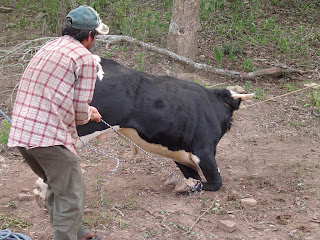 After breakfast, our host went to look for a young bull that had been injured in a fight with another bull. The bull's rear leg looked to be broken and completely unable to sustain any weight, and everyone agreed that what was needed was a little impromptu butchering. In the picture above, two guys had roped the front and back legs of the bull and are forcing it to lay down on its side.
 For some reason, Andy was selected to be the one to hold the bull's head down while the other two guys in this picture did the actual killing. You can see here that Andy is trying his best to get as far away from what's about to happen as possible, but he's got to hold onto that head. If they weren't too graphic, I'd love to show you the succession of photos starting with this one. Andy's left leg keeps getting farther and farther back until he's basically doing the splits, as if by getting that one leg out of there he could keep blood off his hands.
 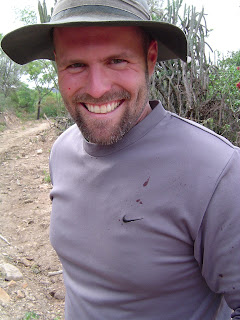 Can you see the blood in his beard?
  After the butchering was done, the rest of the cattle were rounded up, and we drank fresh milk, straight out of the cow (notice the milking going on in the photo).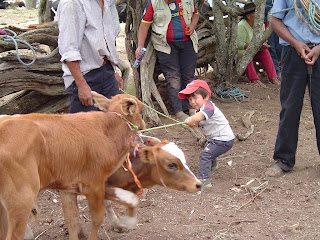
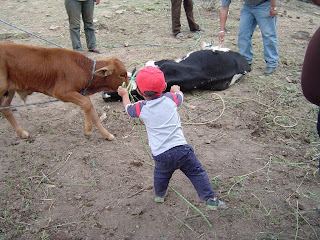 This little guy was determined to rope a calf.
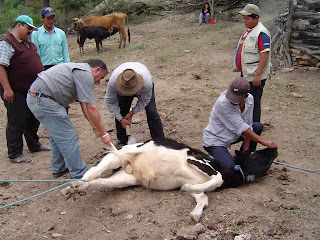 A dozen or so cows had to be branded. Guys would get a rope around the head and back feet of each one, pull it to the ground, then the host would brand it, and, for some reason we never fully understood, he would then rub fresh cow poop on the mark.
 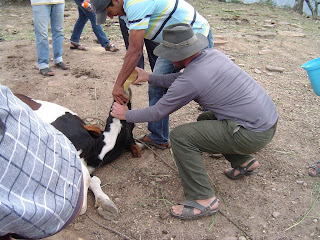 After each cow was branded, someone would feed it a cupful of chicha....
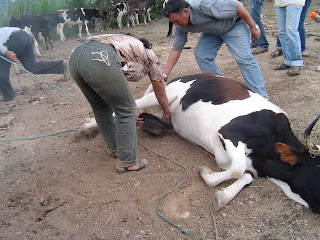 ...and if it was a heifer, the hostess would pretend to milk it into her hat and walk around pretending to give everyone in the group a drink. We understood this ritual to be like a prayer asking for a blessing on this cow's fertility and productivity.
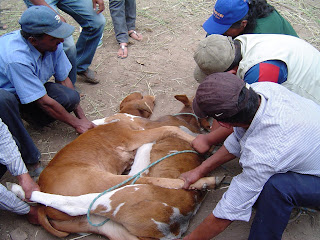 The smallest calves (one male and one female) were laid down in this little cuddling position in another sort of fertility ritual, and then the owners marked them by snipping a corner off each of their ears.
  I also saw this awesome bug.