Thursday, February 10, 2011

Stories

We continue to thoroughly neglect our picture-taking duties, so I will give you the next best thing: stories! Here are a couple that have stuck with us from the last couple months.


Bringing Home My Baby Bumblebee...
Andy has recently ventured into bee-keeping. He bought a bee box, got a little advice and an already-thriving bee family from a neighbor and expert beekeeper, and set the box up on another neighbor's land. A couple months later, the bees seemed to be doing well, and it was time to add on the box they will hopefully use for honey storage. Pressed for time, Andy decided to do this task with less-than-ideal equipment: a pillowcase with a mesh window hurriedly sewn into it for a bee mask, no smoker (which helps to calm the bees down), and whatever clothes he happened to be wearing (instead of light-colored clothes, which supposedly anger them less). When he arrived and set to work, it quickly became obvious that the bees were feeling protective. They swarmed him within the first minute, barely giving him time to place the box before he started feeling them stinging through several layers of clothes and crawling up inside his mask (pillowcase). As soon as he could, he took off running for his motorcycle, hoping that getting away from the hive would end the attack. The presence of a couple bees in his mask (pillowcase) became unbearable, so he ripped it off as he mounted the motorcycle. That's when he realized that the swarm had followed him. As soon as the mask came off, they charged, attacking his face and head. He hit the throttle on the motorcycle, holding on with one hand while desperately swatting away the mob with the other.

When he arrived home, I noticed he looked kind of...puffy. He walked in the house just shaking his head, then told the whole story. An hour or so later, he started complaining that his head still hurt in several places where they had stung him. I had him sit down so I could take a look. I gasped with my first glance. There among the stubble of his nearly-shaved head were half a dozen smashed bee rear ends, embedded with their stingers into his poor swollen scalp and neck. I pulled them out with tweezers, leaving a little bee butt collection on our kitchen table. The swelling didn't get much worse, although he did walk around for a week with one eye half shut. The happy ending came when he told the story to our neighbor and several other experienced bee-keepers. They laughed harder with each rookie mistake he revealed, and kindly advised him how to avoid another painful encounter.


The Princess and the Potato

Our most recent trip to Santa Cruz was begun about 12 hours earlier than expected when, the night before we planned to get on the bus, we caught wind of a truck about to pass through town hauling potatoes to the city. We had always wanted to experience the ride on a potato truck to the city at least once, so we decided to hop on. The advantage of making the trip this way is that you don't have to spend the entire day on a bus, which leaves at 9 a.m. and arrives at 6 p.m. - a whole day lost. Instead, you board the potato truck late in the evening, and then by the next morning you arrive at your destination. But first let me describe what I mean by "ride on a potato truck."


The kind of truck used to haul potatoes here is not very common in the United States. I don't have a picture of an actual Moro Moro potato truck, but imagine something like this:
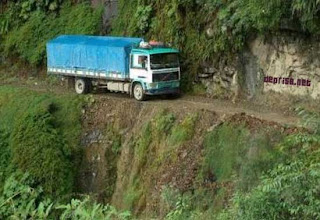
In this particular case, you will need to imagine it a little more run-down and generally non-confidence-inspiring, and that the slatted boards making up the side walls of the bed (which tend to bow out with time) are supported by rubber straps made of used tires. Imagine climbing up the back (there are no stairs, mind you, so you have to make the first step up onto the bumper-like platform in one bound), and dropping down under the tarp into darkness. You feel around beneath you and realize you are crouching on top of potatoes: enormous blue bags full of them. The bags are tossed in willy nilly, so that you have to crawl around in the dusty darkness while the truck sways back and forth, looking for a place where the sacks fell in a way that makes a more-or-less flat surface that you can stretch out on.

In our case, we found acceptable positions with the help of an elderly woman who was also making the trip. She gave helpful advice like, "put that box over there," and, "make sure your neck's not too bent. That hurts." We found ourselves with two traveling companions: the woman, and an older man. He was on his way to visit his wife, and she was going to spend time with her daughter. Since it was nearly pitch dark, we had to ask eachother about 10 times who we were. Once we established that, the man perked up and said, "Now we're going to have a good chat!" And then he and the woman spoke nonstop for 10 minutes about why you can't have a good chat really between only two people, but as soon as there are three or four, well, then you can. This specific good chat covered the usual topics: rain, mud, siblings, potatoes, peaches, city-versus-campo living (the city life is undesirable, of course), bus-versus-potato truck travel, etc. At one point, I retold half-jokingly that Andy and I had been concerned that the tarp over the truck wouldn't allow for much air flow inside. The woman responded with some very helpful information: "Well, no, you see, the air gets in through the open spaces and makes kind of a wind in here, so you don't have to worry about that." (I often find people telling me things that are completely obvious, which makes me wonder if I walk around looking lost and out of place most of the time.)

After the good chat died down, we settled into our places. Sleeping on a bag of potatoes is pretty comfortable at first. Then after half an hour or so, that one tiny tuber that sticks out farther than the rest starts to feel like a tiny fist punching you in the ribs or thigh, and you have to squirm around for a while to find an acceptable new position. At first, too, the swaying of the truck lulled me into sleepiness, but then I started picturing the cliffs and crumbly roads and the possible sleepiness of the driver, and every time I felt the truck breaking or swerving slightly, my heart skipped a beat. Heart skipping is not conducive to sleeping any more than being punched by tiny potatoes. Then, of course, the inevitable need for a bathroom crept up. On the bus, bathroom availability is predictable: there will be one stop in the middle of the trip where there is time to go to the bathroom; that's it. In the back of the potato truck, however, not only did I not have any idea what the driver's plans were, but he was in such a hurry that he never stopped for more than two minutes at a time (long enough for him and his male helpers to jump out of the cab, do their business, and jump back in). By the time I would realize we were stopped, crawl over the potatoes and sleeping old man to the back of the truck, heave myself over the back wall, and identify some tiny bush on the side of the road behind which I could do my thing, the driver's helper would be waving me back into the truck, telling me that the driver was running late and in a big hurry. This happened three times before I resigned myself to the fact that I would just be holding it for the entirety of the 10-hour trip. Have you ever had to go in the middle of the night, but you were feeling lazy and thinking to yourself, "I can just hold it 'til morning, right?" It never works. The longer you lay there trying to convince yourself of this, the more awake you become with the fear that you really will fall asleep and possibly not hold it until morning. You know? I hardly slept at all. Andy, meanwhile, could not be bothered with my complaints about tiny potatoes, imaginary near-collisions, or bathroom issues, because he was out cold almost the entire trip. The next day I inwardly breathed a sigh of relief when our boss told us that, for safety reasons, she prefers we just stick to bus travel.

Wednesday, February 2, 2011

A season of changes

Hi Friends and family!

 It´s been quite a while since we got anything new up here.   As many of you know of you´ve been on a road trip with me, I hate that time of the trip when you´re ALMOST half-way.  Say hour 5 of a 10 hour trip – that little bit of suffering until half-way always seems too long.    Well, its seems what is true of road trips can be true of longer-term commitments too.   Feb 25 marks 17 months for us in Bolivia, and half-way in our contract.   We have struggled a bit in the last couple months to keep our chins up as some projects drug to a halt and we were asked to write plans for the third time because we might need to change the source of funding for our work. 

I assume plenty of you will be reading this right away as you´re all snowed in and hoping the heater stays on!  Here we´re enjoying the peach harvest with the apples son to come!    Jeremy and I are working on an Apple cider press to get some more value out of the non-marketworthy apples, more value for them and for us!

Cassie and I are back in Moro Moro after taking a little time away to sort ourselves out, we´re working hard but in a new direction.  No one knows at this point if we´ll be replaced after our term is up, so our real job for the next 18 months is to work ourselves out of a job by training local technicians to do our jobs – then with the resources of the mayor and perhaps continuing with MCC, they can maintain and expand the water systems without direct involvement from outsiders.   We´re enjoying the task, but progress in the work of training can leave you with a lot fewer signposts to know how far you´ve gone, and how far you have to go.


Here´s a recent photo of our Moro Moro team.    From right to left…

Jeremy Good – one year volunteer from Pennsylvania – working in letrines and erosion barriers

Fernando – local student who just graducated wtih an agronomy degree, and is finishing his practical component with MCC´s sponsorship – working in field trials of organic fertilizers

Nathan Harder – volunteer who´s been here 4 years now, working in organic agricultura and an irrigation project

Patrocinio Garvizu – our buen jefe (good boss) – Officially the rural programs coordinator, lives in Santa Cruz and does a lot of leg work to get us materials and keep us sane when our culture clashes with that of the Moromoreñans

Cassie – Busy as always on executing water systems, leading the church women´s group in a fertilizer course, and most recently,  working her tail off translating plans and getting proposals ready and re-ready as we switch sources of funding (internal to MCC switch – no worries)

ME! – Working as always in water systems and latrines, but now that we have a truck and a larger team, I spend a good bit of time fixing motorcycles and coordinating materials, the truck Schedule, and helping Jeremy on erosion barriers.

Saturday, October 30, 2010

Come see Moro Moro - Virtually

If you`ve ever wondered exactly where we live, check out this link...

We have the ambiguously whitish roof (actually metal) that is indicated on the map. A block SW is the catholic church (yellow). The dark line next to our house is the main drainage ditch for the town. Follow the roads SW and NW of town and you can see our daily commutes. Enjoy!

Google Maps Link to Andy and Cassie's House in Moro Moro


Ver Moro Moro, Bolivia en un mapa más grande

Saturday, August 28, 2010

Cuss words

I’ve been spending a lot of time lately with folks from the Evangelical church. We’re remodeling the sanctuary--what once was literally a one car garage that thanks to an oddly shaped lot, was wide wider at one end. The only entrance was the swinging garage door was a garage door that was either completely open or completely closed. In winter, it was a tough decision to go to church – you needed your stocking cap, long underwear and several sweaters. The decision was even tougher knowing you didn’t have a nice warm house to come home to. So the plan was to take over a chunk of the parsonage and make a 40’ x 15’ room with a real ceiling and closeable small doors.

The thing that has given me the most laughs is the almost cuss words that gt used at church. You know, like we say darn or shoot. Well, to avoid saying the mierda (poop-word), they draw out the syllables of mie-e-e-rcoles (Wednesday). This can be incredibly confusing when they say: Wednesday, we’ve got a lot of work to do. And I respond: But I thought we were working Tuesday!

Bolivia´s Climate Crusade

So you, like me, may have associated Aljazeera only with releasing the latest Taliban announcements. It appears they do some decent journalism as well, and in English! Here’s a great video on climate change´s impact on Bolivia, the role of the “Global South”, and some good thinking on how to move forward with solutions instead of just bickering about punitive damages.

Original link on Al Jazeera:
http://english.aljazeera.net/programmes/faultlines/2010/05/2010518121127315453.html

Youtube link:
http://www.youtube.com/watch?v=wWjHrVJPb-g


Here´s a photo of dad and I exploring some of the same terrain seen in the video. It is quite dramatic seeing up close how the landscape has changed.

A couple excerpts:
“Bolivia is on the receiving end of a crisis they did not create. It’s also a crisis they can’t solve, at least not on their own, and that’s where the climate debt movement comes in. As the U.S. confronts ecological disaster in the Gulf of Mexico, its government is demanding that BP, the polluter, should pay. Bolivia is trying to apply that principal on a global scale.”


“In countries like Bolivia, the climate crisis is impossible to deny. In countries like the U.S., denial is everywhere. Not just the denial of climate skeptics, but the daily denial of millions of people who know the crisis is real, yet somehow can’t summon the urgency to act.”

“How do we find a way for impoverished people and impoverished countries to economically develop in a way that is not at the expense of the environment and that recognized their right to develop, just as the countries in the North had a right to develop?”

“Climate debt: the basic principle is polluter pays. There is finite space for atmospheric greenhouse gas emissions, and the rich world has already used up more than its fair share. For poor countries to develop, they need help to leapfrog the dirty technologies that created our modern world and created the climate crisis.”

Friday, August 6, 2010

June/July in photos

Of course, words often don't do justice to the sights/sounds/smells that we live every day. Here's a few pictures to approach sharing of the sights. We haven't quite figured it out, but we'll keep working on how to share the smells.

I'm in bed with a cold - we were planning to head out of Moro Moro anyway to visit fellow workers in Charagua, near the Chaco desert, and I had the though... I can lay in bed in Moro Moro, or lay in bed in Santa Cruz, and have INTERNET! So here's some pictures to pass your and my time!


A couple of young ladies and their fine harvest of ”morado” (purple) corn – especially good for making api - the famous sweetened ground corn drink. You should have seen them grin and giggle when they told me it wasn't even their corn.


Our front room full of eager readers digging into the bilingual Bible story books sent down by Andy’s mom.


Potato harvest in progress, as viewed from our work site. Each blue bag hold 250 pounds of potatoes and are awaiting horses and burros to haul them out of the field and a strong back to load them on the truck.


Cassie showing off her stained hands after a day of tying re-bar together to create the shell of a ferrocement water tank.


Our friend Adan, working on his new rainwater capturing tank. His metal roof will capture ~30,000 liters of water (7900 gallons) per year, 11,000 liters of which can be stored in the tank for the dry season. If, as planned, the dry season lasts 5 months, his family can use 70 liters (18.5 gallons) per day.

After a 2 hour hike to make measurements on his spring and talk about possibilities for making a water system, Ermenahildo, spry for his 84 years, and his faithful companion weren't going to let me make any errors. They're checking my math.


Tuesday, July 27, 2010

Money

While hosting the visitors from Fresno Pacific University, we got to chatting about money, and I had the thought that I have never put anything about money here. Here’s just a quick view of incomes and expenses here in Bolivia.

The exchange rate for the Bolivian currency, Bolivianos (Bs.), hovers around Bs. 7:$1. Very often, incomes in the US and Bolivia are comparable in their respective currencies – consider the wage for a security guard at Bs. 19,200 – not far from what that job might pay in the US, but in dollars. Now put yourself in his shoes earning $19,200, or even a manager, at $30,000--here is a list of the prices you would face. Consider how your consumption might change…How often would you spend $1.50 per minute talking on your cell phone, or how would your driving habits change if you were paying over $14 for a gallon of gas. It is very interesting the pattern of prices that emerge as you shop. Those things that can be exported, or have to be imported, you pay a world price – say infrastructure and natural gas to make electricity, or Toyota Corollas. If ingredients in its production are exportable, say corn and soy for producing eggs/meat, you pay world prices for that portion, and a poor-country price for the labor. Things that are mostly labor, say daily wages for a mason or eating at a family restaurant, you pay much less.

You can see the paradox – things seem expensive to the average person, but still cheap on the world scale. So while $8.50 shoes that might last 3 years as your only shoes may seem like a bargain, Bs. 60 isn’t too easy to come by, and even after multiple repairs, we see folks working in those shoes until they’ve worn through the soles and hardly any leather keeps them attached.


We list our incomes here, but from these numbers, it’s difficult to equalize them. MCC provides us with a long list of perks that are uncommon here. They provide furniture, life insurance, a computer, motorcycles/gas, and when we’re traveling other than on vacation, MCC pays. Plus we have wonderful families back in the states (as the U.S. is called here) that gift us things out of reach of the average Bolivian. We can also buy things cheap on Ebay and have them brought down by friends—services quite unavailable in a country with undeveloped infrastructure (1 post office in each principal cities). All that to say, even though we have the goal of at least moderate voluntary poverty, we live well comparatively here in Bolivia.

Annual Income: Bolivianos $ U.S. (7:1)
Security guard or driver 19,200 2,743
Teacher (national schools
are only 8:30-12:30)
21,000 3,000
Low-level manager 30,000 4,286
MCC foreign worker
(summed allowances for
food, housing, etc., plus
readjustment allowance)
24,500 3,500
Daily wage for a mason
(semi-skilled day laborer)
80 11

Food:


Gallon of gasoline
(subsidized)
14.21 2.03
Whole frozen chicken (dead,
feathered, and gutted)
28.00 4.00
Pound of sugar 1.59 0.23
Pound of whole wheat flour 1.04 0.15
Gallon of milk (processed) 20.90 2.99
Gallon of milk (fresh from
the cow)
11.40 1.63
Cheapest candy in the store 0.20 0.03
Soup and entreé (family
restaurant)
13.00 1.86
Clothes:

Used pants 25.00 3.57
Locally produced sandals
(leather & tire tread)
60.00 8.57
Other:

City bus fare (no transfers) 1.50 0.21
Dentist visit for cleaning
140.00 20.00
Electricity per kWh 1.00 0.14
Cheapest cell phone 300.00 42.86
Cell phone call per minute 1.50 0.21
Used Toyota Corolla (6-10
yrs old, without title,
steering wheel on the
wrong side)
31,500 4,500
Used Ford Explorer (8 years
old, with papers)
63,000 9,000
Social Services:

Visit to government health
post in rural areas
Free
Birth of a child (medical
care)
Free
Attending a prenatal/infant's
checkup
+25 3.57
A child completes a year of
school
+200 28.57
Senior citizen monthly social
security payment
+200 28.57

Healthcare has been a government priority and it shows. Healthcare is free from birth until 21yrs for all residents (including MCC workers). If the person is in school/college, this coverage extends to 24yrs. Free healthcare is also given to the elderly after 60yrs. In the rural areas that have organized and put health as a priority, there is free basic medical care for everyone. We have an excellent “posta” in Moro Moro, and have 4 doctors for a population of ~3,500 in our municipality. I’ve never waited more than 10 minutes to see the doctor, and the pharmacy is across the hall. National taxes amount to ~15% of income if you work for a registered business, and a sales tax of 13% is charged at large businesses, and at smaller places if you ask for an official receipt, a “factura.” Being an institution, we’re in trouble if we don’t insist on factura receipts.


According the the U.S. State Dept., "The United States forgave almost all of Bolivia’s bilateral debt between 1999 and 2002." Much debt remains however from international institutions such as the International Monetary Fund and International Development Bank. Bolivia qualifies as a "Highly Indebted Poor Country", and debt, equaling 44% of GDP, much lower in real terms, and percentage terms than the U.S.

We have lived in Bolivia 6 weeks shy of a year, and daily discoveries continue in how our lifestyles differ, but our humanity is the same. The subtleties of prices, rural self-sufficiency, shape our context and how we relate to people around us.